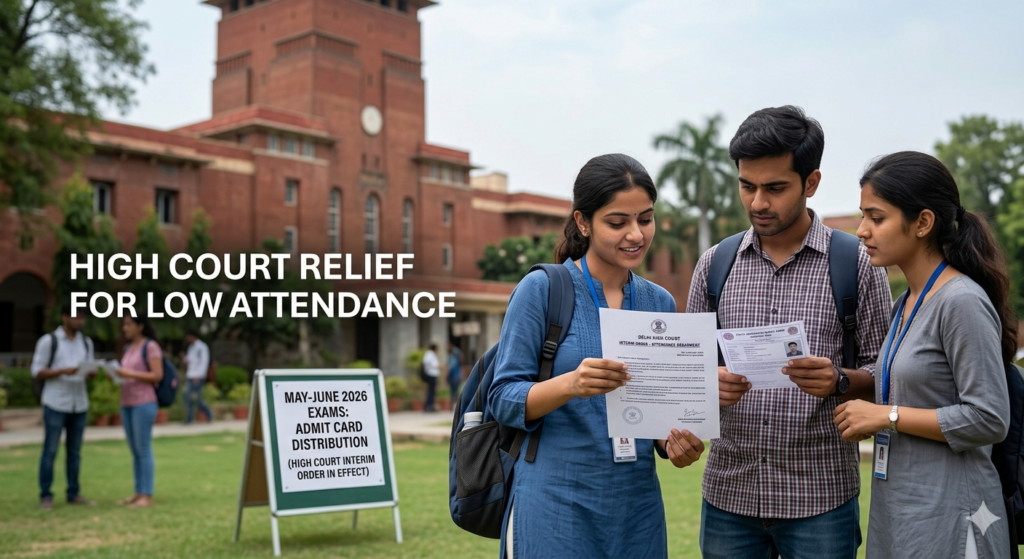
The May-June 2026 semester exam season at Delhi University (DU) has been overshadowed by widespread confusion and panic. Across various colleges, hundreds of students recently found themselves debarred from writing their fourth and sixth-semester examinations due to failing to meet the mandatory 66.67% attendance requirement.
However, in a massive development this week, the Delhi High Court has intervened. If you or someone you know has had their DU admit card withheld over attendance issues, here is a complete breakdown of the recent High Court interim order and exactly what it means for your academic future.
Topics Discussed
Why Were DU Students Debarred?
Delhi University mandates a strict minimum attendance requirement for undergraduate and postgraduate students. As per the university guidelines, students must have at least 66.67% attendance across their lectures, tutorials, and practicals to be eligible to sit for their end-semester examinations.
In early May 2026, several DU colleges strictly enforced this rule, releasing lists of debarred students just days before the exams were scheduled to begin. Affected students argued that the university did not account for medical emergencies, internships, or the fact that the required 60 hours of teaching per course were often not fully conducted by the faculty.
The Delhi High Court’s Interim Relief (May 2026 Order)
Facing immediate academic loss, several affected DU students filed petitions challenging the university’s communications.
In urgent hearings held on May 18 and May 19, 2026, the Delhi High Court provided significant temporary relief. Taking note of the immediate hardship faced by the students, the court issued an interim order directing Delhi University to permit the petitioners to appear for their scheduled May/June semester exams.
The court observed that students should not suffer an immediate and irreversible academic loss while the legal validity of the attendance rule is still being debated in court.
The Catch: Is This a Final Victory?
While the interim order is a massive relief, it is not a final victory.
The Delhi High Court made it explicitly clear that allowing the students to write the exams is a provisional measure. The final results of these examinations will remain strictly subject to the final outcome of the ongoing court case.
The university has been given time to file its counter-affidavit, and the next hearing for this matter is scheduled for May 29, 2026. If the final verdict favors the university, the exams written by the debarred students could be invalidated.
The Supreme Court’s Recent Stance on College Attendance
To understand where this case might head, it is crucial to look at the broader legal landscape surrounding college attendance.
In November 2025, the Delhi High Court ruled that law students could not be barred from exams solely due to low attendance, stating it caused undue mental distress. However, just last week, on May 14, 2026, the Supreme Court of India expressed serious reservations about that 2025 ruling.
The Supreme Court noted that completely doing away with attendance norms would reduce premium colleges to “mere boarding and lodging facilities.” While the Supreme Court has not suspended the old High Court order yet, their critical observations indicate that higher courts are currently leaning towards maintaining academic discipline and attendance rules.
What Debarred DU Students Need to Do Right Now
If you are currently facing a debarment issue in your college, you must act strategically based on these recent legal developments:
- Submit a Formal Grievance: Do not rely on verbal communication. Write a formal application to your college principal and the grievance redressal cell immediately.
- Cite the May 18/19 Interim Order: In your application, specifically mention the recent Delhi High Court interim orders that allowed students with attendance shortages to sit for the current May 2026 exams.
- Attach Valid Proofs: If your low attendance was due to a medical issue, ECA (Extra-Curricular Activities), or sports trials, attach the official medical certificates or society letters.
- Demand Provisional Permission: Request that your college allow you to write the exams provisionally, acknowledging that your final result will depend on the university’s final decision or the upcoming May 29 court verdict.
Keep an eye on the official Delhi University portal (du.ac.in) and upcoming court judgments after May 29, 2026, as the final ruling will set a permanent precedent for DU’s attendance policies moving forward.